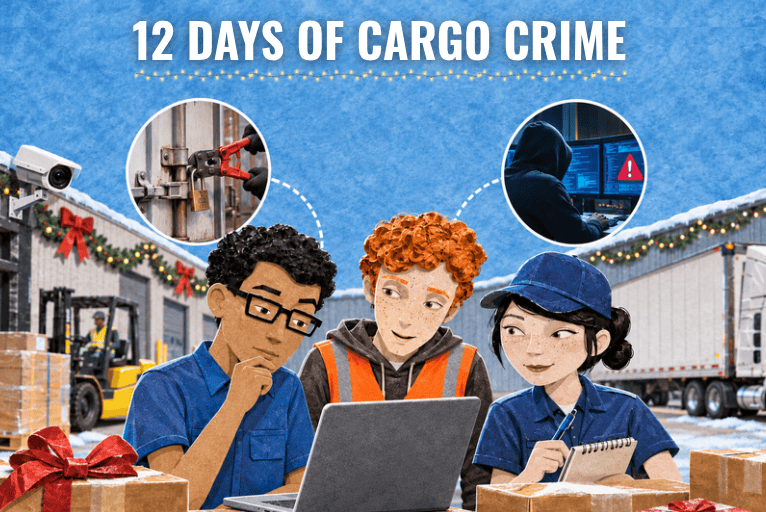
On this, the First Day of the 12 Days of Cargo Crime, the Freight Fraud Prevention Hub (FFPH) is presenting a new series of blog posts, running now through Christmas Eve, to raise awareness of different cargo crime schemes, including cargo theft, freight fraud, and cyber-enabled cargo crimes. We will discuss how criminals take advantage of short staffing, tight schedules, and divided attention to misdirect, steal, and defraud shippers, brokers, and motor carriers during a season that is supposed to be merry and bright.
What is cargo crime?
Broadly speaking, these are the schemes employed by criminals to deprive the lawful owner of physical or virtual assets for the criminal enterprise to use or sell. Cargo theft ranges from full trailer and container theft to strategic pilferage, fictitious pickups, and shipment diversion schemes targeting high-value goods.
Freight fraud uses deception and impersonation to convince carriers to drop off cargoes as if it were a legitimate transaction. And cyber-enabled cargo crime utilizes technology to gain unauthorized access to information systems or to hijack business processes to support theft or fraud. Sometimes the cargo crime is less about theft than about holding the critical information systems infrastructure hostage and demanding a ransom.
What to expect
Each “Day” in this series will follow a similar format, with the intention that you can read it in a few minutes and find guidance for controls that you can put to work at your company after lunch.
- The cargo crime scheme: what it is and how it works, illustrated with a real incident available from public sources.
- The players: who is often involved in the scheme, whether organized criminal enterprises, insider threats, or impersonators.
- Countermeasures: practical advice for controls that your team can apply right away.
- Additional resources: links to the National Motor Freight Traffic Association (NMFTA), FFPH, law enforcement, and other authoritative resources for deeper reading.
Some schemes use old-fashioned stealth and muscle – sneak up to a trailer under the cover of darkness, use bolt cutters on the lock, and make off with the valuables found inside. Other schemes rely on impersonating an entire trucking company with the purchase of a defunct motor carrier (MC) number, complete with falsified safety records and driver qualifications. Still others leverage gaps in data integrity to misroute cargo from its intended destination. We will be covering all of these topics and more.
Unwrap a new cargo crime scheme with NMFTA
Bookmark the FFPH blog and check back from now until Christmas Eve for each installment. Share it with your drivers, dock supervisors, and anyone who answers the phone when a “dispatcher” calls about a load. The best gift you can give your customers this season is freight that arrives where it was sent.